
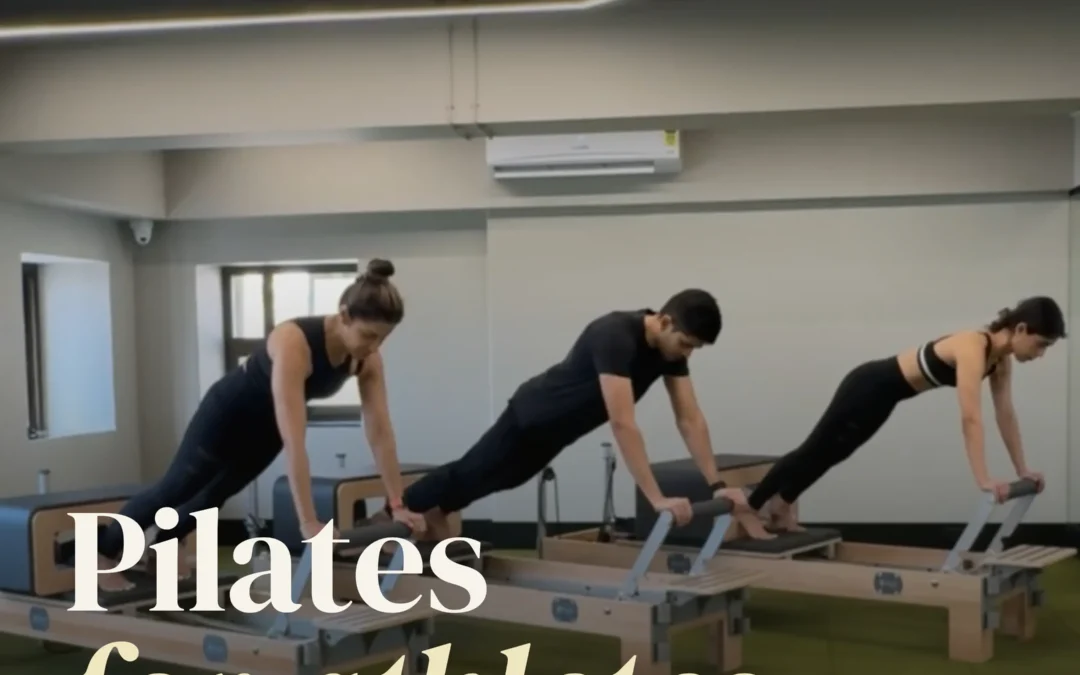
The athletes who get the most out of Pilates are usually the ones who did not think they needed it.
Cricketers with strong shoulders but a stiff thoracic spine. Runners with quick legs but a weak deep core. Footballers who can sprint but cannot decelerate cleanly. Gym-goers who can deadlift twice their bodyweight but cannot stand on one leg without wobbling.
These are the gaps Pilates for athletes is built to close. Not by replacing the work that is already happening on the field or in the gym, but by training the layer underneath it. The control, stability, and movement quality that make every other piece of training work harder.
Recreational sport in Mumbai is in a different place than it was ten years ago. The IPL has built a generation of weekend cricketers across the city, from kids in coaching academies in Andheri and Borivali to corporate sides playing inter-office tournaments at Cooperage. The ISL has done the same for football. Running culture has exploded along every promenade and park. Gym performance has gone from niche to mainstream. The city now has more serious recreational athletes training year-round than at any point in its history, and a growing number of them have started showing up in private Pilates sessions at YKBI. Not because Pilates is trendy, but because their existing training had a ceiling, and Pilates was the thing that broke through it.
Why pure strength and conditioning is not enough
Most athletic training is built around output. How fast, how strong, how many reps. The assumption is that if you make the engine more powerful, performance follows.
That works up to a point. Then it stops.
The reason it stops is that performance is not just power. It is how cleanly that power transfers through your body. A cricketer with strong legs and a leaky core will lose force on every drive. A runner with tight hips and weak glutes will recruit the wrong muscles for stride after stride, mile after mile. A footballer with poor ankle and hip stability will land asymmetrically thousands of times in a season, and one of those landings is the injury.
Pilates targets exactly this: the leaks. The compensations. The small instabilities that bleed power out of every movement and stack up into chronic injury patterns over time.
What athletic Pilates actually trains
The term “athletic Pilates” gets used loosely. The structure is still classical Pilates (Reformer, Mat, Cadillac, Chair), but the programming shifts to what an athlete’s body actually needs.
A typical session for an athlete focuses on four things.
- Core stability under load. Not crunches. Anti-rotation, anti-extension, and anti-flexion work that teaches the deep core to hold position while the limbs move powerfully around it. This is the missing link in most rotational sports like cricket, golf, and tennis, where power comes from the trunk transferring force, not the arms generating it.
- Joint stability and tracking. Single-leg work, scapular control, ankle and knee alignment under fatigue. The drills are slow, but they retrain the small stabilisers that protect joints when training picks up speed.
- Mobility without losing strength. Most athletes are either too tight or too mobile. Pilates trains end-range strength: the ability to produce force at the limits of your range, not just hold a stretch. This is why athletes who add Pilates often get more usable mobility without the joint laxity that pure stretching can create.
- Recovery and movement quality. Pilates loads the body in ways that complement, rather than fight, sport-specific training. Most athletes report better recovery, less DOMS the day after heavy training, and noticeably less of the chronic stiffness that piles up across a season.
What changes for the athlete after 8 to 12 weeks
The shift is rarely dramatic in the first month. The compound effects start showing up around the eight-to-twelve-week mark of consistent practice. Typically one or two sessions per week, alongside existing training.
Cricketers report a more stable trunk through the drive and more rotational power without lower-back strain. Runners notice a quieter stride, less wasted lateral motion, and less hip and IT-band irritation on long runs. Footballers describe sharper change-of-direction and better balance under contact. Gym-goers find that lifts they had plateaued on start moving again, usually because the limiting factor was stability, not strength.
The pattern is the same across sports: training begins to feel cleaner. Less fighting with the body. More force going where it is supposed to go.
This is what athletes mean when they say Pilates “carries over.” It is not that the exercises mimic their sport. It is that the underlying movement quality improves, and everything they already do gets sharper as a result.
What the research actually says
Studies on Pilates and athletic performance, across rugby, soccer, swimming, dance, and recreational running, consistently show measurable improvements in core endurance, dynamic balance, and trunk stability after eight to twelve weeks of structured Pilates training. Several studies also report reductions in self-reported lower-back pain and lower-limb overuse injuries in athletes who add Pilates to their existing programmes.
The evidence is not a guarantee that Pilates will improve every athlete’s specific performance metric. But the body of research is large enough that almost every elite training environment now uses some form of Pilates or Pilates-derived stability work as part of standard programming. There is a reason for that.
How to use Pilates if you are already training hard
A few practical principles for athletes adding Pilates to an existing programme.
Start with one or two sessions per week. More than that, and you risk overlapping recovery demands with sport-specific work.
Use private or duet sessions early on. The corrective value of Pilates depends on a trainer seeing your specific compensations. Group classes are valuable later, once your patterns are established.
Be honest about your weak link. Most athletes lead with strengths and avoid weaknesses. Pilates only pays off if you let the trainer programme around what your body is actually missing.
At YKBI, our trainers across the Juhu, Bandra, and Marine Drive studios run private athletic Pilates sessions for cricketers, runners, footballers, and gym-based clients. The programming is specific to the sport and the athlete in front of us, not a generic class adapted for athletes.
If your training has plateaued, or you keep picking up the same small injuries, the gap is usually not in how hard you are working. It is in what you are not training. Pilates closes that gap.
Frequently Asked Questions
-
Is Pilates good for athletes?
Pilates is one of the most effective complementary training methods for athletes because it targets the deep core stability, joint control, and movement quality that sport-specific training and gym work usually miss. Athletes across cricket, running, football, swimming, and combat sports use Pilates to improve performance and reduce injury risk.
-
How often should an athlete do Pilates?
For most athletes already training in their sport, one to two Pilates sessions per week is enough to see meaningful improvements in stability, mobility, and movement control. Athletes in heavy in-season periods may drop to one session per week. Athletes in pre-season or recovery blocks may benefit from two to three.
-
Can Pilates replace gym training for athletes?
Pilates does not replace strength and conditioning for athletes who need maximal strength and power. It works best alongside gym work, addressing the stability, control, and mobility gaps that traditional strength training does not target.
-
Does Pilates help with sports injuries?
Pilates is widely used in sports rehabilitation and injury prevention. It targets the muscle imbalances, joint instability, and compensation patterns that drive most overuse injuries, particularly in the lower back, hips, knees, and shoulders. Many physiotherapists in Mumbai now refer athletes to Pilates as part of their return-to-sport programmes.
-
Is Reformer Pilates or Mat Pilates better for athletes?
Reformer Pilates is generally more useful for athletes because the spring resistance lets you load movements progressively and train end-range strength under control. Mat Pilates remains a strong base, particularly for core endurance, but most athletic programming at YKBI uses Reformer as the primary tool.
-
Where can I do athletic Pilates in Mumbai?
YKBI offers private and duet Pilates sessions for athletes at our Mumbai studios in Juhu, Bandra, and Marine Drive, with trainers experienced in working across cricket, running, football, and gym-based performance.
Want to add Pilates to your training? Book a private session at YKBI Juhu, Bandra, or Marine Drive. Our trainers will build a programme around the gaps your sport is leaving behind.