
The question comes up at almost every gathering where I mention what I do. Someone has been practising yoga for years. They feel good about it. But they have started hearing about Pilates, and they want to know: is it just yoga with different equipment? Or is it something else entirely? And do they have to choose?
I have been teaching Pilates for 2+ decades, and I have never thought of the two practices as competitors. But over two decades of watching the same clients move between both disciplines, I have developed a specific view of what each method does and does not do for the body. That view is more nuanced than most of what you find online, which tends to frame this as a competition with a winner at the end.
There is no winner. That is the wrong question. Yoga and Pilates are built on different foundations, ask different things of the body, and serve different purposes. Many people who want a complete movement practice need both. The question is not which one wins.
It is which one you are currently missing. That is the answer I want to give here, honestly, from over two decades of teaching Pilates in India alongside practitioners who have spent their lives studying yoga.
Where the two methods come from, and why it matters
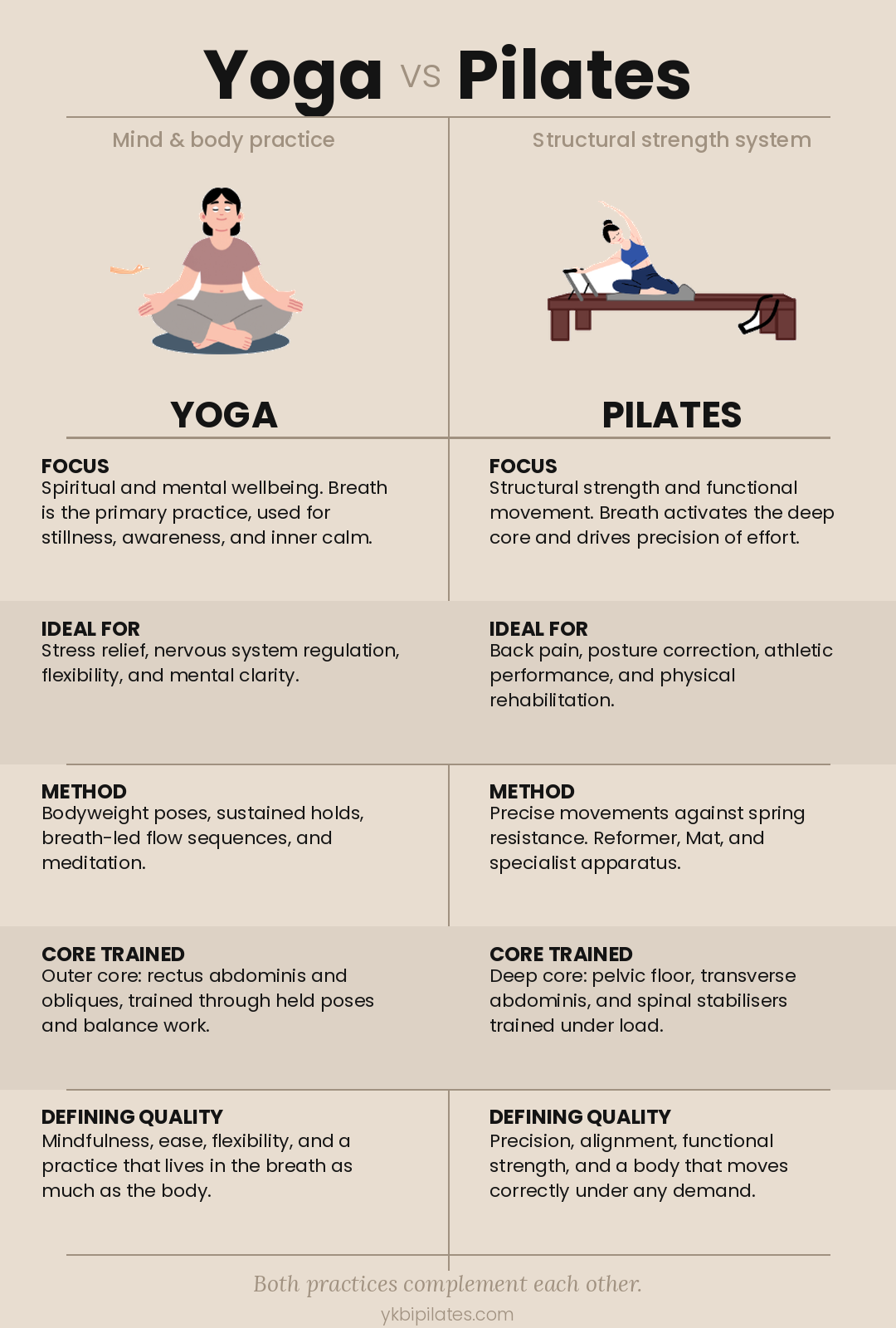
Yoga’s origins are spiritual, meditative, and philosophical long before they are physical. The postures, the breath, the lineage of teacher and student passing down a practice across centuries. The body in yoga is a vehicle. The destination is something beyond it.
Pilates was designed in the early twentieth century by Joseph Pilates, a German gymnast, boxer, and physical rehabilitation specialist. He was interested in one specific problem: how do you build a body that functions correctly? The philosophy is structural. The method is mechanical. Every exercise exists to restore or develop the physical capacities the body needs to move well and stay pain-free.
This difference in origin explains almost everything about how the two practices feel. Yoga begins with the breath and the mind, and the body follows. Pilates begins with the body, and precision is the practice. Both require discipline. Both reward consistency. But they are not trying to do the same thing, and understanding that distinction is the first step toward knowing which one your body needs right now.
| Goal | Pilates | Yoga |
| Core Strength | Excellent | Good |
| Flexibility | Good | Excellent |
| Posture | Excellent | Good |
| Back Pain Support | Excellent | Good |
| Stress Relief | Good | Excellent |
| Balance | Good | Excellent |
| Rehabilitation | Excellent | Moderate |
| Mindfulness | Moderate | Excellent |
What Pilates trains that yoga rarely covers
Pilates is, at its core, a strength system. This is the part that surprises most people before they try it.
The work is not about holding poses or flowing through sequences. It is about loading the body through specific movement patterns, with precise control and resistance, to build strength in the deep stabilising muscles that most exercise ignores. The transverse abdominis. The pelvic floor. The small muscles along the spine. The intrinsic rotators of the hip. The shoulder stabilisers that hold the shoulder blade against the rib cage during arm movement.
These muscles do not respond to a plank hold or a sun salutation in the way Pilates directly targets them. They are the layer underneath visible movement, and they determine whether everything else works correctly. When they are underused, the larger muscles compensate. The lower back overworks. The knees track incorrectly. The neck holds tension that the shoulders should be absorbing. Movement becomes effortful in places it should not be.
The Reformer adds something yoga cannot: resistance across the full range of motion. This trains end-range strength, the ability to produce force at the limits of your flexibility rather than simply hold a stretch at the edge of it. The result is a kind of functional strength that transfers into everyday life in ways that are easy to underestimate. Carrying weight without wrenching the back. Climbing stairs without the knees objecting. Sitting for eight hours without the spine gradually collapsing. The small, constant things that accumulate into how your body feels at fifty, and at sixty.
What yoga does that Pilates does not
Yoga works on the nervous system in ways that Pilates does not try to.
The quality of a sustained yoga hold, the breath as the primary object of attention rather than a tool to serve movement, the inward attention that a well-taught class invites. These ask something different from the body and the mind. The result is a settled presence, a capacity to release tension rather than only to build structure, that a Pilates session does not specifically develop.
Yoga also carries philosophical and spiritual dimensions that Pilates does not have. Many practitioners find that their yoga practice changes how they relate to their bodies, their stress, and their lives in ways that go beyond the physical. Pilates makes no such offer. It is a body method, focused on how the physical structure moves and supports itself.
There is also the question of logistics. Yoga, once learned, can be practised anywhere: a mat, a clear space, and a basic understanding of the sequences. Pilates, done well, requires guidance. The precision that makes the method effective also makes self-teaching it unreliable. This is not a flaw. It is a feature. But it does make Pilates a different kind of commitment, and that matters when you are deciding where to start.
The core strength question: where the real difference shows
This is the comparison I get asked about most directly. Is Pilates vs yoga a meaningful distinction when it comes to core strength?
The honest answer is that it depends on what you mean by core.
Yoga builds real core strength. Crow pose. Boat pose. Extended side angle. The core that yoga trains is largely the visible muscular structure: the rectus abdominis, the obliques, the outer abdominal wall. The strength is largely isometric and static. You hold a shape, and the core works to maintain it.
Pilates trains the core underneath that. The pelvic floor. The transverse abdominis that wraps the entire midsection. The deep spinal stabilisers that hold the vertebrae in alignment under load. These muscles do not produce a visible six-pack. They produce the way you move: cleanly, efficiently, without the lower back seizing when you bend or the knees aching when you climb stairs.
For functional core stability, the kind that protects the spine and makes every other movement safer and more efficient, Pilates is the more targeted system. For a practice that develops core strength through varied, dynamic, exploratory movement rooted in breath and intention, yoga offers something Pilates does not try to match. The two are not doing the same work, even when the exercises can look similar from the outside.
Who benefits most from each practice, and when to start
I do not prescribe one practice over the other. But watching bodies change over two decades of teaching across Mumbai and beyond, I have noticed consistent patterns.
People who come to Pilates with a yoga background tend to have good flexibility and genuine body awareness. They understand breath. They are comfortable with slow, deliberate movement. But they often have weak deep stabilisers. Their end-range strength has not been trained. The pelvic floor is frequently under engaged. Pilates addresses this directly and often quickly, because the body awareness is already there.
People who come to yoga with a Pilates foundation tend to have strong stabilisers but may hold tension in ways that prevent them from moving fully into poses. Yoga softens that. The two practices are genuinely complementary in a practical sense that I have watched play out in studios across Juhu, Bandra, Matunga and Marine Drive.
For the professional who sits at a desk for eight or more hours a day: Pilates first. The structural work addresses what long hours of sitting strips from the body. Then yoga, for the nervous system regulation that consistent work pressure erodes.
For someone in their fifties or sixties protecting their mobility for the decades ahead: start with Pilates to build the structural foundation, then let yoga sustain what Pilates builds. The combination is powerful for longevity.
For the serious athlete or regular gym-goer who already trains hard: Pilates closes the gaps that sport and conditioning miss. Yoga supports recovery and release. Both earn their place in the week.
For someone entirely new to movement: either works as a starting point. The right choice is the one you will actually show up to consistently, because consistency is the only thing that changes a body.
Why the most complete practitioners usually do both
At YKBI, I see clients who have practised yoga for twenty years walk in and discover muscles they did not know were underused. I see clients who have done Pilates consistently for years find that yoga gives them a quality of ease in their bodies that structural work alone cannot produce.
The most complete movers I know practice both. Not because they have unlimited time, but because the two methods address genuinely different needs, and one does not reliably fill in for the other. Yoga gives the nervous system and the spirit something Pilates does not offer. Pilates gives the structure something yoga alone cannot build.
If I had to summarise what two decades of practising and teaching in India have taught me, it is this: the question is not “Pilates or yoga.” The question is what your body is asking for right now, and whether you are listening. Most people find that once they try both seriously, the question answers itself. The body tends to know which gap needs closing before the mind catches up.
If you have questions about which practice is right for you, the best answer usually comes from trying a session of each with a qualified teacher. The questions you walk out with will tell you more than any article can.
Frequently Asked Questions
-
Is Pilates better than yoga for core strength?
For deep core stability, including the pelvic floor and spinal stabilisers, Pilates is the more targeted system. Yoga builds real outer core strength through poses like boat and plank, but Pilates specifically trains the deeper layer that protects the spine and supports functional movement. The two systems train different aspects of core strength rather than competing directly.
-
Can I do both Pilates and yoga at the same time?
Yes, and many experienced practitioners do. Pilates builds the structural foundation: deep core strength, joint stability, precise movement control. Yoga develops the nervous system, breath, flexibility, and body awareness in ways Pilates does not try to. Together they address a wider range of what the body needs than either does alone.
-
What is the main difference between Pilates and yoga?
Yoga is rooted in breath, awareness, and philosophical tradition. Pilates is a structural strength method designed to build the deep stabilising muscles most exercise ignores. Yoga asks the body to find ease in stillness and range of motion. Pilates trains the body to produce force with control and precision. Both require discipline, but they begin from different places.
-
Is Pilates harder than yoga for beginners?
Neither is uniformly harder. Yoga can be demanding at the level of flexibility and balance. Pilates is demanding at the level of deep muscular control and precision, often in movements that look deceptively simple. Beginners typically find Pilates surprising because the work is specific and exacting even at low intensity. The real difficulty in both is showing up consistently.
-
Which is better for back pain, Pilates or yoga?
For back pain specifically, Pilates is the more targeted approach. It directly trains the deep core stabilisers and spinal muscles that support the spine, while releasing the tight hip flexors and chest that contribute to lower-back compression. Yoga can support recovery too, but Pilates addresses the structural cause of most mechanical back pain more directly.
-
Is yoga or Pilates better for flexibility?
Both improve flexibility, but differently. Yoga typically produces greater range of motion through sustained stretching and mobility work. Pilates improves functional flexibility, range of motion you can control and use under load. Pilates clients often find their flexibility becomes more usable because it is supported by strength. The right answer depends on whether you want more range or more control.
-
Where can I do Pilates in Mumbai?
YKBI offers Pilates classes and private sessions across studios in Mumbai, including Juhu, Bandra, and Marine Drive. Sessions are led by certified instructors trained through the YKBI Pilates Academy. Classes run on Reformer, Mat, and specialist equipment. You can book through ykbipilates.com or contact your nearest studio directly.
Curious which practice your body is asking for? Try a Pilates session at YKBI and see what comes up. Our trainers across Juhu, Bandra, and Marine Drive will meet you exactly where you are.