
Six weeks after her son was born, a client stood in our Bandra studio and told me she had been doing her kegels every day. Dozens of them. In the car, at her desk, waiting for the kettle. The leaks when she sneezed had not stopped. If anything, her lower back felt worse and her core felt further away than ever. She wanted to know what she was doing wrong.
She was not doing anything wrong. She was doing the one thing everyone tells you to do, and it was not working, because Pilates for the pelvic floor is not about squeezing harder. It is about teaching a group of muscles to do their job at the right time, with the right amount of effort, as part of a system. Most people never hear that part.
The pelvic floor is having a moment. Search interest in it has climbed sharply, and for good reason. More women are talking openly about leaks, prolapse, and the long road back after childbirth. But most of the advice still stops at do your kegels, which is a little like being told to fix your posture by sitting up straight. Useful for a second. Useless as a plan.
What the pelvic floor actually is, and why it matters more than you think
The pelvic floor is a group of muscles that sits like a hammock at the base of your pelvis. It runs from your pubic bone at the front to your tailbone at the back. It holds up your bladder and bowel, and in women the uterus too. It controls when you go to the bathroom and when you wait. It plays a quiet part in core stability, in breathing, and in sexual function.
You do not see it. You rarely feel it until something goes wrong. And plenty can go wrong. Pregnancy and birth stretch and load it. Years of sitting weaken it. Chronic constipation strains it. High-impact exercise without support can overload it. Menopause changes the tissue itself. By the time most people think about their pelvic floor, it has been asking for attention for a while.
Here is the part that surprises people. A pelvic floor problem is rarely just a pelvic floor problem. These muscles work as part of a deep core system. When they stop coordinating with the rest of that system, the symptoms show up elsewhere. As leaks. As heaviness. As lower back pain. As a stomach that will not flatten no matter how many crunches you do.
Why clenching harder is usually the wrong instinct
Most pelvic floor advice assumes the muscles are weak. Sometimes they are. Just as often, they are too tight.
A tight pelvic floor cannot contract well, because it is already half contracted all the time. Asking it to squeeze harder is like asking a clenched fist to grip something. There is no range left to use. This is why so many women do hundreds of kegels and feel no better. They are loading a muscle that needs to learn how to let go before it can learn how to work.
You do not fix a pelvic floor by clenching harder. You fix it by restoring its full range, its timing, and its connection to your breath and your deep core. That is a movement skill, not a strength contest. It is also exactly what good Pilates teaches.
This is the gap in most of what you read online. The standard list of five exercises assumes every pelvic floor is the same. Yours is not. The right starting point depends on whether your floor is weak, tight, or, very commonly, both in different places.
How Pilates trains the pelvic floor
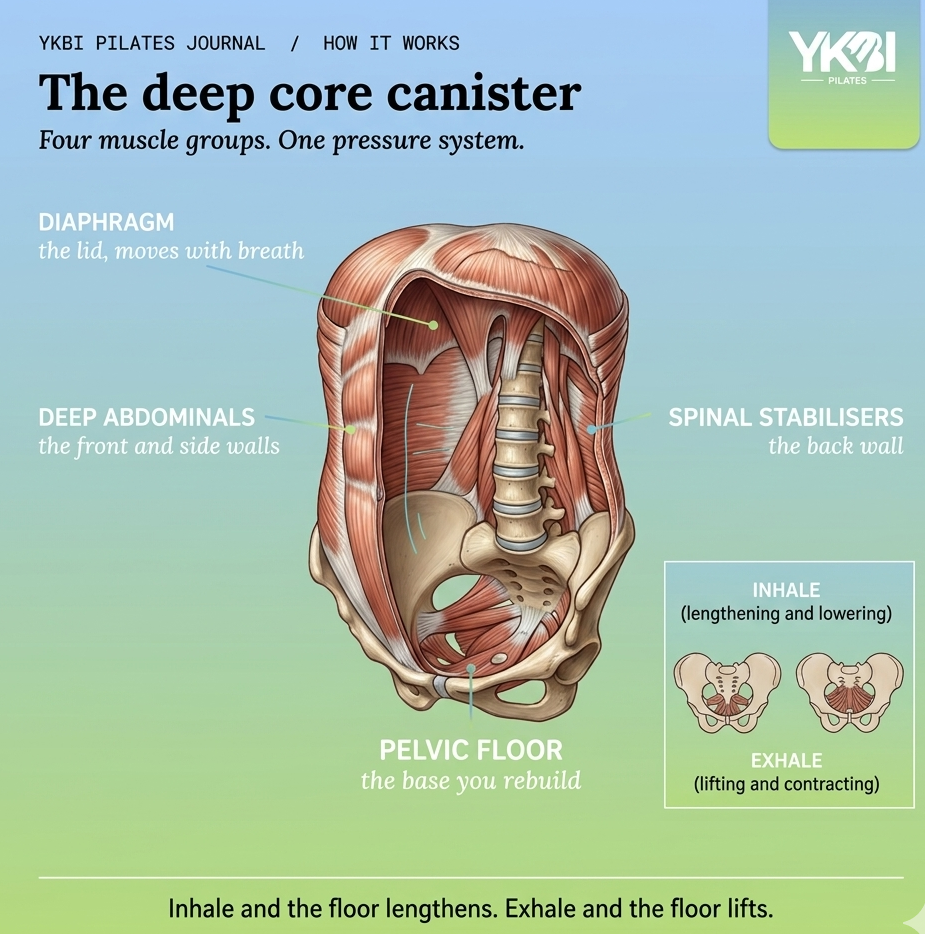
Pilates works the pelvic floor through the deep core system, not in isolation. Picture your torso as a canister. The diaphragm is the lid. The deep abdominals wrap the front and sides. The small muscles along the spine form the back. The pelvic floor is the base. These four work together, every breath, every time you lift or bend or sneeze.
When you breathe in well, the diaphragm drops and the pelvic floor gently lengthens. When you breathe out, the diaphragm rises and the pelvic floor naturally lifts. This rhythm is the foundation of everything we do. Before we add any strength, we rebuild this breath to floor connection, because a pelvic floor that moves with the breath is a pelvic floor that can work on demand.
From there, Pilates adds load slowly. A bridge teaches the floor to engage while the hips work. A controlled roll down teaches it to manage pressure as the spine moves. Reformer work adds resistance in positions that protect the spine and the pelvis. Every progression has a reason. Nothing is random, and nothing is rushed.
This is why guidance matters so much here. The same exercise can help one person and aggravate another, depending on what their pelvic floor actually needs.
Pelvic floor Pilates after pregnancy
Pregnancy and birth are the most common reasons women come to us for this work. The pelvic floor carries the weight of a growing baby for months. Birth, whether vaginal or by caesarean, adds its own demands. The abdominal wall stretches, and the two halves of the main abdominal muscle often separate, a condition called diastasis recti.
Rushing back into hard core work after this does more harm than good. Crunches and planks can push pressure down onto a floor that is not ready. That can widen the gap in the abdominal wall and make leaks worse. The order matters. Breath and deep core first. Pelvic floor coordination next. Visible strength last.
Postpartum Pilates done well rebuilds the system from the inside out. We start gentle, often within the limits your doctor has set, and we progress only when the body shows it is ready. Many women tell us this is the first time anyone explained what was actually happening in their body, instead of handing them a workout. That understanding is what separates months of frustration from a recovery that holds.
What this work can and cannot do
It helps to be honest about this, because the internet rarely is.
Pilates can meaningfully improve a pelvic floor that is weak, poorly coordinated, or recovering from pregnancy. Many women see fewer leaks, steadier core control, and less back pain within a couple of months of consistent practice. It can ease the heaviness of a mild prolapse and help you exercise without making symptoms worse. For most people, it is one of the safest and most effective ways to rebuild this part of the body.
What Pilates cannot do is replace medical care. A significant prolapse, ongoing pain, or leaks that do not respond to training need a women’s health physiotherapist or a doctor. Pilates works best alongside that care, not instead of it. A good trainer will tell you when something is beyond the mat and point you to the right person. Anyone who promises to fix every pelvic floor problem with movement alone is overselling.
Set against that honesty, the results are encouraging. The pelvic floor responds well to the right work. It just has to be the right work, in the right order, for long enough to matter.
What a pelvic floor session looks like at YKBI
A first session begins with a conversation and an assessment. We ask about your history, your symptoms, your pregnancies if relevant, and your goals. We watch how you breathe, because your breath tells us more about your pelvic floor than any single exercise can.
From there the work is specific to you. For a tight floor, we start with release and lengthening before any strengthening. For a weak floor, we rebuild the breath connection and add gentle load. For the common mix of both, we do both, in the right order.
The pace is slow on purpose. This is not a class you leave drenched in sweat. It is a class you leave understanding your own body a little better. Across our Mumbai studios in Juhu, Bandra, and Marine Drive, every session is led by an instructor trained through the YKBI Pilates Academy. For pelvic floor work, that training is not a nice extra. It is the whole point, because this is the kind of work that goes wrong without it.
Pelvic floor health is not a niche concern or a problem only new mothers face. It sits at the centre of how your whole core works, at every age. If you have been doing your kegels and wondering why nothing is changing, the missing piece is usually not more effort. It is better guidance. Here are the questions we hear most often.
Signs Your Pelvic Floor May Need Attention
-
leaking when sneezing
-
leaking when exercising
-
feeling heaviness in the pelvis
-
lower back discomfort
-
difficulty engaging the core after pregnancy
Frequently Asked Questions
-
Does Pilates strengthen the pelvic floor?
Yes, when it is taught well. Pilates trains the pelvic floor as part of the deep core system, linking it to your breath and the muscles around your spine and abdomen. This coordinated approach works better than isolated squeezing for most people, because the pelvic floor is built to work with other muscles, not alone.
-
Can Pilates help with bladder leaks?
Often, yes. Many leaks happen because the pelvic floor cannot produce force at the right moment, such as when you sneeze, laugh, or lift. Pilates retrains that timing and rebuilds strength gradually. Most women notice fewer leaks within a couple of months of consistent practice. Persistent leaks should also be checked by a women’s health physiotherapist.
-
Is Pilates safe for the pelvic floor after childbirth?
Yes, and it is one of the better choices, as long as you start at the right time and the right level. Wait for your doctor’s clearance, usually around six weeks, and begin with breath and deep core work before any loaded exercise. Avoid rushing into crunches or planks, which can strain a recovering pelvic floor and abdominal wall.
-
Can Pilates make a tight pelvic floor worse?
It can, if the teaching is poor. A tight, overactive pelvic floor needs to learn to release before it strengthens. Loading it with more contractions can add tension and worsen symptoms. A trained instructor checks for this first and starts with lengthening and breath. This is why guidance matters more than the exercises themselves for pelvic floor work.
-
How long does Pilates take to improve the pelvic floor?
Most people notice early changes, such as fewer leaks or steadier core control, within four to eight weeks of two sessions per week. Deeper, lasting change in strength and coordination usually takes around three months. Consistency matters more than intensity. The pelvic floor responds to regular, correct practice, not the occasional hard effort.
-
Is Pilates for pelvic floor better than kegels?
For most people, yes. Kegels train one action, a squeeze, in isolation. Pilates for pelvic floor trains these muscles to coordinate with your breath and core across real movement, which is how they actually work in daily life. Kegels can help, but they rarely solve the problem on their own, especially when the floor is tight rather than weak.
-
Where can I do pelvic floor Pilates in Mumbai?
YKBI offers pelvic floor and postpartum Pilates across our Mumbai studios in Juhu, Bandra, and Marine Drive, along with our other locations in Delhi NCR, Hyderabad, and beyond. Every session is led by an instructor certified through the YKBI Pilates Academy, and we work alongside your doctor or physiotherapist where needed.
Tired of doing your kegels and seeing nothing change? Book an introductory session and let a YKBI trainer assess what your pelvic floor actually needs. Juhu, Bandra, or Marine Drive.